

7 Questions Greater Lansing Seniors & Families Should Ask
Staying Home Can Be a Great Choice—When the Home Still Works for You
Most people I talk with don't begin by saying, “I want to move.” 
More often, I hear something like:
“I'd really like to stay in my home if I can.”
And in many cases, they can.
Aging in place can be an excellent choice when your home remains safe, manageable, affordable, and compatible with the life you want to live.
But there's an important difference between choosing to age in place and simply staying because you haven't explored the alternatives.
The purpose of this guide isn't to convince you to move. It's to help you take an objective look at your home, lifestyle, support system, finances, and future needs so you can decide what makes sense for you.
Planning ahead doesn't mean you're planning to move. It means you're giving yourself more choices.


Start With These 7 Questions
Before worrying about where you might move or whether you should sell your home, start by looking at how well your current home is
working for you.
These seven questions can help.
Aging in Place or Moving? 7 Questions Greater Lansing Seniors Should Ask
1. Does My Home Still Fit My Everyday Needs?
A home that worked beautifully 20 or 30 years ago may not fit your life quite as well today.
Maybe you're using only a fraction of the house. Perhaps the laundry is in the basement, bedrooms are upstairs, or you're maintaining rooms that rarely get used.
Ask yourself:
Do I still use and enjoy most of my home?
Are the rooms I need most easy to reach?
Could I comfortably live primarily on one level if necessary?
Is the amount of space helping my lifestyle—or creating more work?
Having unused space isn't necessarily a reason to move. But maintaining a home that no longer matches the way you live is worth considering.
2. Is Maintaining My Home Becoming More Work Than I Want?
There's a question I think seniors sometimes overlook.
It's not simply:
“Can I still take care of my house?”
It's also:
“Do I still want to?”
Lawn care, snow removal, cleaning, gutters, landscaping, repairs, painting, appliances, heating and cooling systems—the responsibilities of homeownership don't disappear when we retire.
You may be perfectly capable of handling them and still decide you'd rather spend your time doing something else.
And remember, many of these jobs can be hired out. Aging in place doesn't mean you have to continue doing everything yourself.
The question is whether the time, expense, and responsibility of maintaining the home still make sense for you.
You don't need to predict the future.
But it makes sense to ask whether your home could adapt if your needs changed.
Take a fresh look at:
- Stairs and steps
- Bathrooms
- Entryways
- Lighting
- Flooring
- Handrails
- Doorway widths
- Bedroom location
- Laundry location
- Access from the garage or driveway
Sometimes relatively modest improvements—better lighting, additional railings, grab bars, or a safer bathroom—can make a meaningful difference.
Other homes may require more substantial modifications.
The objective isn't to make your house ready for every possible circumstance. It's to understand how adaptable your home really is.
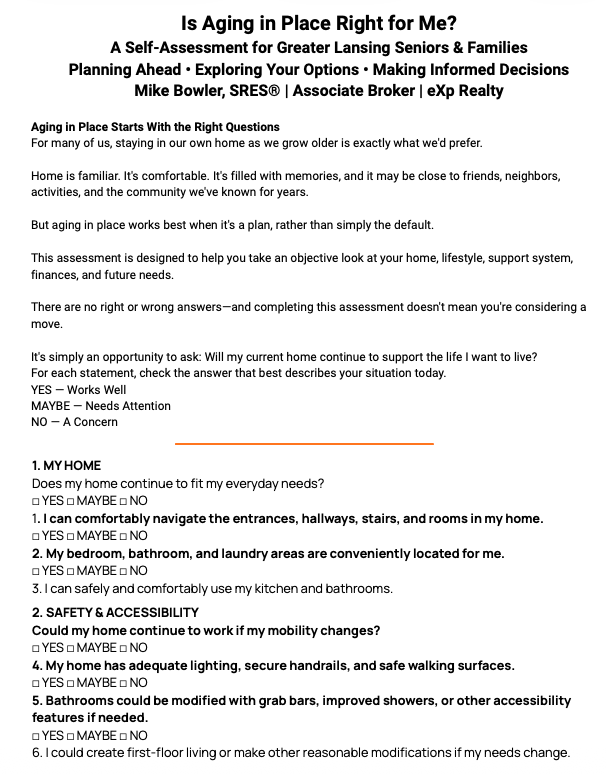
Is Aging in Place Right for Me?
A Self-Assessment for Greater Lansing Seniors & Families
Sometimes it's easier to evaluate your situation when the questions are in front of you.
I've developed an Aging in Place Self-Assessment to help you look at your home, maintenance, safety, transportation, social connections, support system, finances, and future plans.
There is no “passing” or “failing” score.
Instead, look for patterns in your answers.
4. Can I Get Where I Need—and Want—to Go?
Transportation is about much more than getting to a doctor's appointment.
Think about everything that makes up your normal life:
Family.
Friends.
Shopping.
Restaurants.
Community activities.
Entertainment.
Medical appointments.
Haircuts.
The library.
Your favorite coffee shop.
What happens if driving becomes more difficult—or you simply decide you don't want to drive as much?
Consider whether your location gives you realistic alternatives through family, friends, community transportation, delivery services, or other local resources.
A home can be physically comfortable but become increasingly isolating if it's difficult to get anywhere from it.
5. Am I Staying Connected?
This question deserves just as much attention as stairs and bathrooms.
One of the advantages of remaining in a longtime home is familiarity. You may know your neighbors, enjoy your community, have friends nearby, and feel deeply connected to where you live.
That's a strong argument for staying.
But circumstances change.
Friends move. A spouse may pass away. Driving habits change. Children may live farther away. Activities that once provided regular interaction may become less frequent.
Ask yourself:
Am I seeing people as often as I'd like?
Do I have activities I look forward to?
Can I easily spend time with family and friends?
Would another living arrangement improve—or reduce—my social connections?
This isn't about how many activities appear on a community calendar.
It's about the life you want to live.
6. What Does Staying in My Home Really Cost?
Comparing the cost of staying home with another housing option isn't as simple as comparing a mortgage payment with monthly rent at a senior community.
If you're evaluating the financial side of aging in place, consider the whole picture:
Property taxes
Homeowners insurance
Utilities
Routine maintenance
Major repairs
Lawn and landscaping
Snow removal
Housekeeping
Transportation
Home modifications
Potential in-home assistance
Some homeowners have very low housing expenses and find aging in place financially attractive.
Others discover that once they account for everything they're spending to maintain the house and lifestyle, the difference isn't as large as they expected.
The purpose isn't to prove that one choice costs less.
It's to compare accurately.
7. What Do I Want My Life to Look Like 3–5 Years From Now?
This may be the most important question on the entire page.
Instead of asking only:
“Can I stay in my home?”
Try asking:
“Is this home helping me live the life I want?”
Think beyond the house itself.
What would you like your next several years to look like?
Would you like to travel more?
Spend less time maintaining a property?
Live closer to children or grandchildren?
Have more opportunities to socialize?
Remain in your neighborhood?
Have everything on one floor?
Spend less—or perhaps simply have more predictable expenses?
There isn't a correct answer.
Your answer is what matters.
10 Signs It May Be Time to Start Planning
Sometimes the decision doesn't begin with one major event.
It's a collection of little things.
The house is becoming harder to maintain. Stairs aren't as comfortable. You're using fewer rooms. Driving at night isn't as appealing. Family members are starting to ask questions.
None of these automatically means it's time to move.
But several of them together may suggest it's time to start planning.
10 Signs It May Be Time to Start Planning a Senior Move
10 Signs Self-Assessment
Use this short assessment to identify areas that may be worth discussing or planning for.

What Could Make Aging in Place Easier?
If you decide you'd like to remain in your current home, the next question becomes:
What would make staying easier, safer, or more enjoyable?
You may not need a major renovation.
Depending on your circumstances, solutions might include improved lighting, railings or grab bars, bathroom modifications, lawn and snow services, housekeeping, meal assistance, transportation, home maintenance help, or in-home support.
The key is identifying potential challenges before they become urgent problems.
Greater Lansing Resources That May Help
Greater Lansing has organizations and service providers that can help older adults remain independent.
This is where I would retain and update the strongest local resources from your existing page, including categories such as:
Area Agency on Aging resources
Aging in Place Isn't a Permanent Decision
You can decide today that staying home makes sense.
That doesn't mean you can never reconsider.
Circumstances change.
It's worth taking another look after:
- A significant change in health or mobility
- A fall or new safety concern
- Loss of a spouse or caregiver
- Increasing difficulty maintaining the home
- Changes in driving or transportation
- Increasing isolation
- Significant changes in housing expenses
- A change in what you want from retirement
Reassessing doesn't mean your earlier decision was wrong. It means your circumstances may have changed.
Aging in Place vs. Moving
There are good reasons for both.
Staying May Make Sense When...
Your home remains manageable and affordable.
It can accommodate your current and reasonably anticipated needs.
You have a strong support system nearby.
You're socially connected.
You enjoy your home and neighborhood.
And most importantly, you want to stay.
Exploring a Move May Make Sense When...
Home maintenance has become more responsibility than you want.
Accessibility is becoming difficult.
You're using very little of the house.
Transportation or isolation is becoming a concern.
You'd like to be closer to family.
Housing expenses are becoming burdensome.
Or another housing option simply offers a lifestyle that appeals to you more.
Neither list makes the decision for you.
It simply helps clarify the conversation.
What Are the Alternatives?
Moving doesn't automatically mean assisted living.
That's an important misconception.
Depending on your circumstances, your choices might include:
Downsizing to a smaller home
Moving to a condominium
Moving closer to family
Multigenerational living
55+ or active adult housing
Independent living
Assisted living
Memory care when appropriate
I've created a separate guide specifically to help Greater Lansing families understand these choices.
If you decide you'd like to investigate senior living, I've also developed local directories to give you a starting point.
Independent Living
Explore Greater Lansing independent living communities, 55+ options, and senior apartments.

Assisted Living
Identify Greater Lansing assisted living communities to research, contact, and visit.

Memory Care
A resource for families beginning to research Greater Lansing memory care communities.

I'd keep these three relatively small on this page. They're available when needed without creating the impression that the Aging in Place page is trying to funnel everyone toward senior living.
Planning Ahead Gives You More Choices
One of the biggest advantages you can give yourself is time.
You don't need to know today whether you'll move next year, five years from now, or never.
But understanding your options can make future decisions much easier.
What Happens When You Wait Too Long to Make Senior Housing Decisions?
Planning ahead isn't about putting a moving date on the calendar. It's about having a Plan A—and knowing what Plan B might look like.
Helping a Parent Age in Place?
Adult children often see things differently than their parents.
You may notice the stairs.
They see the home where they raised their family.
You may see maintenance.
They see independence.
You may be thinking about what could happen next year.
They're thinking, “I'm doing fine today.”
Those perspectives don't have to become a conflict.
Start with questions rather than conclusions.
Ask what's working well.
Ask what's becoming more difficult.
Ask what would make staying home easier.
And most importantly, include your parent in decisions that affect their life.
Helping Aging Parents Move & Plan Ahead
You Don't Have to Decide Today
Maybe you'll work through these questions and decide your current home still works beautifully.
That's a good outcome.
Maybe you'll identify two or three changes that would make staying home easier.
That's a good outcome too.
Or perhaps you'll realize you'd like to begin exploring other possibilities.
That's also a good outcome.
The purpose of planning isn't to move.
It's to understand your choices while they're still yours to make.
Not Sure What Comes Next?
The Bowler Transition Path™ is a simple planning framework I've developed to help Greater Lansing seniors and families work through housing and transition decisions one step at a time.
You don't need to have all the answers before you begin.
Sometimes the first step is simply having a conversation.



FAQ — Aging in Place in Greater Lansing
What does aging in place mean?
Aging in place generally means continuing to live safely and independently in your current home as you grow older. It may involve making changes to the home, arranging help with maintenance or transportation, using in-home services, or developing a plan for additional support if your needs change.
How do I know if aging in place is right for me?
Start by looking at more than whether you can remain in your home. Consider whether the home is safe and manageable, whether you can comfortably afford its ongoing costs, whether transportation and support are available, how socially connected you are, and whether the home fits the lifestyle you want for the next several years.
What should I consider before deciding to stay in my home?
Consider accessibility, stairs, bathrooms, home maintenance, transportation, proximity to family and healthcare, social connections, finances, and your support system. It's also worth asking how easily the home could adapt if your mobility or other needs changed in the future.
What home modifications can make aging in place easier?
Depending on the home and individual needs, improvements might include better lighting, handrails, grab bars, safer bathrooms, easier-to-use door hardware, improved entryways, or creating more convenient first-floor living. For significant accessibility changes, consider having the home evaluated by an appropriately qualified professional.
Is aging in place less expensive than moving to senior living?
Not always. The comparison depends on your home and the alternative you're considering. When calculating the cost of staying, include property taxes, insurance, utilities, maintenance, repairs, lawn care, snow removal, transportation, possible home modifications, and any in-home assistance you may need. Compare the total costs, not simply a mortgage payment with a senior community's monthly fee.
How can I help an aging parent who wants to stay in their home?
Begin by listening. Ask your parent what is working well, what has become more difficult, and what would make staying at home easier. Rather than beginning the conversation with “You need to move,” explore safety, maintenance, transportation, social connections, finances, and available support together. Respecting your parent's preferences can lead to a much more productive conversation.
When should we reconsider an aging-in-place plan?
Aging in place should be periodically reassessed. A significant change in health or mobility, a fall, loss of a spouse or caregiver, difficulty maintaining the home, changes in driving, increasing isolation, rising expenses, or changing lifestyle priorities can all be reasons to take another look. Reconsidering the plan doesn't mean the original decision was wrong—circumstances may simply have changed.
What senior housing alternatives are available in Greater Lansing?
Depending on individual needs and preferences, alternatives may include downsizing to a smaller home or condominium, moving closer to family, multigenerational living, 55+ or active adult housing, independent living, assisted living, or memory care. Exploring these options doesn't mean you've decided to move; it simply helps you understand what's available.
[BUTTON: Explore Senior Housing Options in Greater Lansing]
About Mike Bowler
I'm Mike Bowler, Associate Broker with eXp Realty and a Seniors Real Estate Specialist® (SRES®). I've served Greater Lansing homeowners for more than four decades.
My wife Sharon and I also experienced downsizing personally, which reinforced something I've seen professionally many times:
The real estate transaction is often only one small part of a much larger life transition.
My role is to help seniors and families understand their housing choices, connect with appropriate resources, and make informed decisions at their own pace.
“Expect The Best” Mike 
Mike Bowler SRES, CRB, ePRO
eXp Realty LLC
517-755-8168
6639 Centurion Dr. Lansing, MI
Mike@MikeBowler.com
Website: MikeBowler.com
Visit My YouTube Channel
https://bit.ly/eXpRealtyMikeBowler