


A Guide for Greater Lansing Seniors
How to start meaningful conversations, avoid family disagreements, and create a housing transition plan that respects everyone's concerns.
By Mike Bowler, Associate Broker, eXp Realty | SRES®, CRB®, ePRO®
A Conversation That Can Make All the Difference
For many older homeowners, the decision to downsize, move closer to family, or explore senior living options begins long before a home is placed on the market.
It often starts with a simple question:
"Should we begin thinking about what comes next?"
That question can lead to some surprisingly emotional conversations.
A longtime home represents much more than its market value. It's where children grew up, holidays were celebrated, friendships developed, and decades of memories were created.
For adult children, the conversation may be about safety, maintenance, transportation, or concerns about a parent's future.
For parents, it may be about independence, familiarity, privacy, and maintaining control over their own decisions.
Both perspectives deserve to be heard.
After more than four decades working with Greater Lansing homeowners and families, I've learned that successful housing transitions often begin with something much simpler than a moving plan.
They begin with a thoughtful family conversation.
Whether you're considering downsizing in Delta Township, Grand Ledge, DeWitt, Holt, Haslett, Okemos, East Lansing, or elsewhere in Greater Lansing, the following guidance can help your family approach the discussion with greater confidence.
1. Start the Conversation Before a Crisis Forces Decisions
One of the most common challenges families face is waiting until circumstances make a decision urgent.
A fall, unexpected illness, loss of a spouse, or growing difficulty maintaining a home can suddenly change the situation.
When that happens, families may find themselves making several important decisions at once.
Where should Mom or Dad live?
What happens to the house?
Who will help coordinate everything?
How quickly must decisions be made?
Beginning the conversation early allows time to explore possibilities without committing to a move.
It also gives the older homeowner an opportunity to participate fully in decisions about the future.
Planning ahead doesn't mean you've decided to move. It means you're preserving choices.
A good place to begin might be:
"What do you think you'd like the next five years to look like?"
Or:
"Are there things about maintaining the house that you'd like to make easier?"
These questions encourage discussion rather than confrontation.
2. Remember Whose Decision It Is
Adult children often approach these conversations with good intentions.
They may worry about an aging parent's safety, the cost of maintaining a large home, or what might happen during an emergency.
Those concerns are understandable.
However, parents may hear something entirely different.
They may feel that their independence is being questioned or that family members have already decided what should happen.
That's why the conversation should begin with respect for the older adult's wishes and decision-making authority.
Rather than saying:
"You really need to move somewhere smaller."
Try:
"Have you thought about whether this home will continue to meet your needs in the years ahead?"
The difference is significant.
One statement presents a conclusion.
The other invites participation.
Whenever possible, the older homeowner should remain at the center of the process, with appropriate professional support when questions of health, safety, or decision-making capacity arise.
3. Explain the Reasons Behind Your Concerns
Family members sometimes disagree because they're discussing solutions before identifying the underlying concerns.
An adult daughter might suggest selling the family home because she's worried about her father's ability to manage the stairs.
Her father may interpret the suggestion as criticism of his independence.
Both may become frustrated without ever discussing the actual concern.
A more productive conversation begins by explaining the reason behind a suggestion.
For example:
"I'm concerned about the stairs, and I'd like us to explore ways to make things safer. That might mean changes to the house rather than moving."
This approach leaves room for alternatives.
Perhaps the home can be modified.
Perhaps maintenance assistance would help.
Perhaps moving to a condominium or independent living community deserves consideration.
The objective is not to arrive at the fastest answer. It's to understand the problem before choosing a solution.
4. Ask Questions and Listen Before Offering Solutions
Sometimes the most helpful thing an adult child can do is listen.
Before discussing real estate values, senior communities, or moving schedules, ask questions that help everyone understand what matters most.
Consider starting with these five:
1. What do you enjoy most about living in your current home?
2. What responsibilities or activities have become more difficult?
3. What would you want to preserve if you eventually moved?
4. What concerns do you have about changing your living arrangements?
5. What information would help you feel more comfortable considering your options?
These questions can uncover important priorities that might otherwise be overlooked.
A parent may be less concerned about the size of the home than about leaving familiar neighbors.
Another may welcome the idea of downsizing but worry about sorting through decades of belongings.
Someone else may be interested in independent living but uncertain about the costs.
Understanding these concerns helps families explore appropriate options.
Related Video: How to Start the Conversation With Aging Parents About Moving
5. Keep Family Members Informed Without Creating Confusion
When several adult children or relatives are involved, communication becomes especially important.
One family member may live nearby and provide regular assistance.
Another may live outside Michigan and receive occasional updates.
A third may have strong opinions but limited firsthand knowledge of the situation.
Without a shared understanding, misunderstandings can develop.
Consider establishing a simple family communication plan.
With the older homeowner's agreement, identify who should participate in discussions, what information should be shared, and how updates will be communicated.
A family meeting, group call, or shared written summary can help everyone work from the same information.
It may also help to identify one family member as a communication coordinator.
That person doesn't necessarily make decisions. Instead, they help organize information, schedule discussions, and keep everyone informed.
The goal is to support cooperation while respecting the homeowner's privacy and preferences.
6. Understand the Emotional Side of Leaving a Longtime Home
A house can hold a lifetime of memories.
The kitchen where holiday meals were prepared.
The backyard where children played.
The family room where everyone gathered.
The familiar neighborhood that has been part of everyday life for decades.
For someone who has lived in the same home for 30, 40, or even 50 years, moving can feel like leaving part of their personal history behind.
That's why downsizing isn't simply a matter of deciding which furniture will fit in a smaller home.
It can involve grief, uncertainty, nostalgia, and excitement—all at the same time.
Families can make the process easier by acknowledging those emotions.
Allow time to share stories.
Take photographs of meaningful spaces.
Preserve important family keepsakes.
Avoid rushing decisions about sentimental belongings.
And remember that someone can recognize the practical benefits of moving while still feeling sadness about leaving.
Both feelings can exist together.
Related Video: The Emotional Side of Helping Aging Parents Move
7. What Happens When Parents and Adult Children Disagree?
Disagreements are common during major family transitions.
An adult child may believe moving is the safest choice.
A parent may strongly prefer remaining at home.
Siblings may disagree about timing, costs, or who should take responsibility for different tasks.
When these situations arise, try to separate the concerns from the proposed solutions.
Instead of debating whether someone should move, identify the issues everyone wants addressed.
For example:
Is home maintenance becoming difficult?
Are there transportation concerns?
Is the home becoming less accessible?
Would additional services make remaining at home more practical?
Are there financial considerations that need professional review?
Once the concerns are identified, families can evaluate alternatives together.
Sometimes a neutral professional can help clarify available choices.
An elder law attorney may assist with legal questions.
A financial advisor may help evaluate financial considerations.
Healthcare or senior care professionals may help families understand support needs.
A Seniors Real Estate Specialist® can provide guidance on housing options, property preparation, and possible sale timing.
Not every disagreement requires an immediate decision.
Sometimes the most productive outcome is agreeing to gather more information and revisit the conversation later.
Related Video: When Adult Children and Aging Parents Disagree About Moving
8. Explore Housing Options Before Deciding What Happens to the House
One mistake families can make is focusing on selling the home before determining where the homeowner would prefer to live next.
The housing decision should come first whenever circumstances allow.
Options may include:
Aging in place: Remaining in the current home with modifications, maintenance assistance, transportation, or in-home support.
Downsizing: Moving to a smaller house or condominium with fewer maintenance responsibilities.
Moving closer to family: Choosing a location that provides more convenient access to relatives and support.
Independent living: Exploring a community designed for older adults who generally manage daily activities independently but may appreciate available amenities and services.
Assisted living: Considering a setting that offers assistance with certain daily activities and personal care needs.
Memory care: Exploring specialized support when appropriate for a person's cognitive and care needs.
The right choice depends on individual circumstances.
Families should compare services, costs, accessibility, location, and future needs rather than relying solely on appearances or general descriptions.
Greater Lansing offers a variety of senior housing possibilities, and learning about them before a move becomes necessary can help families make better-informed decisions.
Helpful Resource: Greater Lansing Independent Living, Assisted Living & Memory Care Directory
9. Put the Family's Plan in Writing
Once conversations begin producing useful information, it's helpful to document the next steps.
A written plan doesn't need to be complicated.
It might include:
The homeowner's priorities and preferences
Current concerns about the home or living arrangements
Housing alternatives worth exploring
Financial and legal questions requiring professional advice
Family members responsible for gathering information
Property maintenance or preparation needs
A tentative timeline
A date to revisit the plan
A written summary can prevent misunderstandings and reduce the need to repeat the same conversations.
It also helps family members who live outside Greater Lansing remain informed.
The plan should remain flexible.
Circumstances change, and decisions may need to be reconsidered.
The purpose of a transition plan is to provide direction—not create unnecessary deadlines or pressure.
Free Family Planning Checklist
To help families get started, I've created a practical resource:
Family Conversation & Senior Housing Decision Checklist
This two-page worksheet helps seniors and adult children identify priorities, discuss concerns, explore housing options, and agree on appropriate next steps.
10. Know When to Involve Professional Resources
Major housing transitions often involve questions beyond real estate.
Families may need guidance concerning financial planning, legal documents, healthcare needs, property maintenance, estate considerations, or senior living arrangements.
No single professional should be expected to answer every question.
The most effective approach is often a coordinated one.
For example, an elder law attorney may address powers of attorney, estate documents, and other legal matters.
A financial advisor may help evaluate retirement income, housing costs, and the financial implications of different options.
Senior housing professionals can explain the services and accommodations available within their communities.
A Seniors Real Estate Specialist® can help homeowners understand the market, property preparation, selling considerations, and how a possible home sale fits into the larger transition.
Working with appropriate professionals helps families obtain reliable information without placing unnecessary pressure on one family member to manage everything.
11. Helping Greater Lansing Families Navigate Housing Transitions
As an Associate Broker with eXp Realty and a Seniors Real Estate Specialist® (SRES®), I've spent decades helping Greater Lansing homeowners navigate important real estate decisions.
Over time, I've learned that senior housing transitions require a different approach from a typical home sale.
They often involve multiple family members, emotional considerations, professional resources, and decisions that should be made in a thoughtful sequence.
That's why I developed the Bowler Transition Path™, a step-by-step approach designed to help homeowners and families understand their options, prepare appropriately, and move forward with confidence.
My role isn't to tell someone when they should move.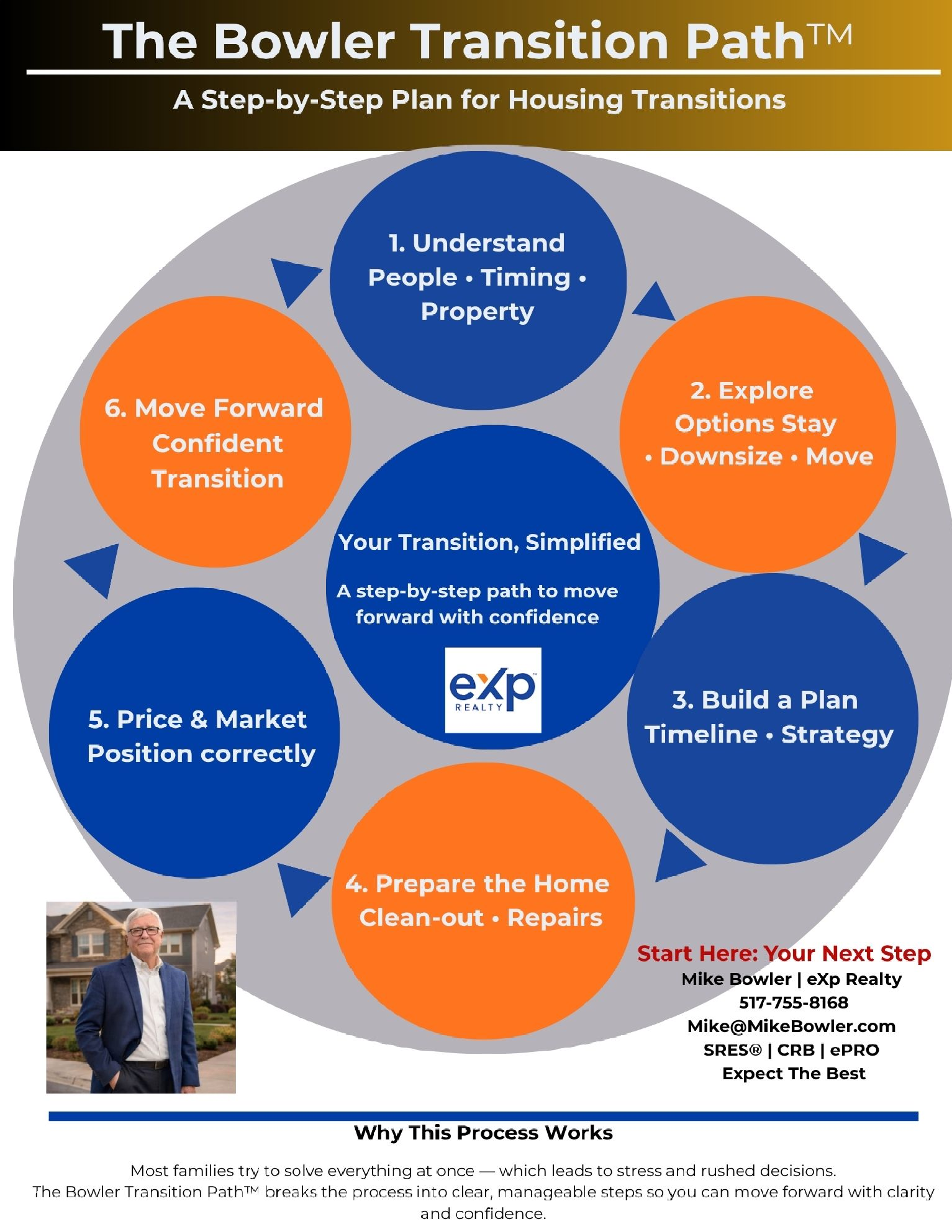
It's to provide practical housing guidance, explain the real estate considerations, and help families coordinate the property-related parts of a larger transition plan.
Sometimes that means preparing a home for sale.
Sometimes it means developing a plan for a possible move next year.
And sometimes the most appropriate decision is to remain in the current home.
If it's not the right time or the right decision, there's no reason to force it.
More Resources for Greater Lansing Families
I've created additional educational materials to help seniors and adult children navigate these decisions.
Helping Aging Parents Move Resource Center
Helping Aging Parents Move: Step-by-Step Video Series
Independent Living, Assisted Living & Memory Care Directory
These resources are intended to help families learn, compare choices, and prepare at their own pace.
Frequently Asked Questions About Family Conversations and Senior Housing Decisions
1. How can I tell my adult children I'm thinking about downsizing without making them worry?
Begin by explaining why you're considering a change and what you hope to accomplish. Perhaps you're interested in less home maintenance, living closer to family, or having more freedom to travel. Let your children know whether you're simply exploring possibilities or actively considering a move. Being clear about your intentions helps family members understand that planning ahead doesn't necessarily mean something is wrong or that an immediate decision is needed.
2. Should all adult children be involved in decisions about a parent's home?
Not necessarily. The homeowner should determine who participates in discussions whenever possible. Some families benefit from including everyone in an initial conversation, while others prefer one family member to coordinate information and updates. What matters is establishing clear expectations, respecting privacy, and avoiding misunderstandings. Family involvement does not automatically give adult children authority to make decisions about a parent's property.
3. How do we discuss selling the family home when everyone has emotional attachments?
Acknowledge that the home may hold different memories and meanings for each family member. Give everyone an opportunity to share what matters to them, but distinguish emotional concerns from practical housing decisions. Preserving photographs, family keepsakes, and meaningful stories can help honor the home's history. Ultimately, the homeowner's preferences and circumstances should guide the decision, subject to any applicable legal authority.
4. What information should families put in writing before making a housing decision?
A simple written summary can identify the homeowner's priorities, reasons for considering a change, housing alternatives, financial questions, property preparation needs, and possible timing. It should also identify who will research specific issues, how family members will communicate, and when the plan will be reviewed. The document doesn't need to be complicated. Its purpose is to reduce misunderstandings and provide a shared reference as circumstances change.
5. What should we do when family members live in different cities or states?
Establish a communication plan that includes the homeowner and appropriate family members. Consider scheduling periodic video or telephone conversations, sharing written updates, and identifying a trusted local contact to help coordinate appointments or property-related tasks. Families with parents in Greater Lansing may also benefit from working with local professionals who understand senior housing options, property preparation, and the real estate market. Clear responsibilities help distant family members participate without creating unnecessary confusion.
6. How can a Senior Real Estate Specialist® help with family housing discussions before a decision to sell?
A Seniors Real Estate Specialist® (SRES®) can provide information about the current housing market, property values, preparation considerations, potential selling timelines, and how a future home sale might coordinate with downsizing or senior housing plans. This information can help families evaluate practical options without requiring an immediate listing decision. Legal, financial, and healthcare questions should be directed to appropriately qualified professionals. The objective is to help the homeowner and family make informed housing decisions with confidence.
Final Thoughts: A Conversation Today Can Make Tomorrow Easier
Talking with family about downsizing or moving isn't always easy.
There may be different opinions, difficult emotions, and questions that don't have immediate answers.
That's normal.
What matters is creating an environment where people feel respected, informed, and included.
Begin with a conversation.
Listen carefully.
Explore the options.
Write down the next steps.
And remember that planning for the future doesn't mean giving up independence or making a commitment to move.
It means preparing thoughtfully for whatever comes next.
The best senior transitions begin with understanding, not urgency.
Let's Talk About Your Family's Next Chapter
If you're considering downsizing, helping an aging parent, or exploring senior housing options in Greater Lansing, I welcome the opportunity to be a resource.
A planning conversation can help you understand your home's potential market position, identify sensible preparation steps, and consider how real estate decisions might fit into your family's broader plans.
There's no obligation to sell and no pressure to make a decision.
Helping Greater Lansing Families Navigate Life's Housing Transitions.
Expect The Best.
SRES® | CRB® | ePRO®
517-755-8168
6639 Centurion Dr. Lansing, MI
Mike@MikeBowler.com
Website: MikeBowler.com
Visit My YouTube Channel
https://bit.ly/eXpRealtyMikeBowler